
As the number of new energy vehicles on the road climbs rapidly, charging infrastructure has moved into a new stage of development — from simply "having it or not" to a whole new set of questions: how fast it charges, how easily it can be built, how economical it is, and how efficiently it operates. Demand for high-power fast charging keeps surging across urban public parking lots, highway service areas, logistics and heavy-truck depots, and commercial parks, raising the bar for equipment integration, land utilization, and construction and delivery efficiency.
Conventional high-power charging stations generally use a split architecture of box-type substation + charging rectifier cabinet + charging terminals. While this approach is technically mature, its shortcomings become increasingly apparent in megawatt-scale, high-power station projects: numerous cabinets, a large footprint, complex electrical connections between devices, heavy cable consumption, extensive on-site installation and commissioning work, and long construction cycles. In space-constrained cities and older industrial parks, such projects are often limited by available space.
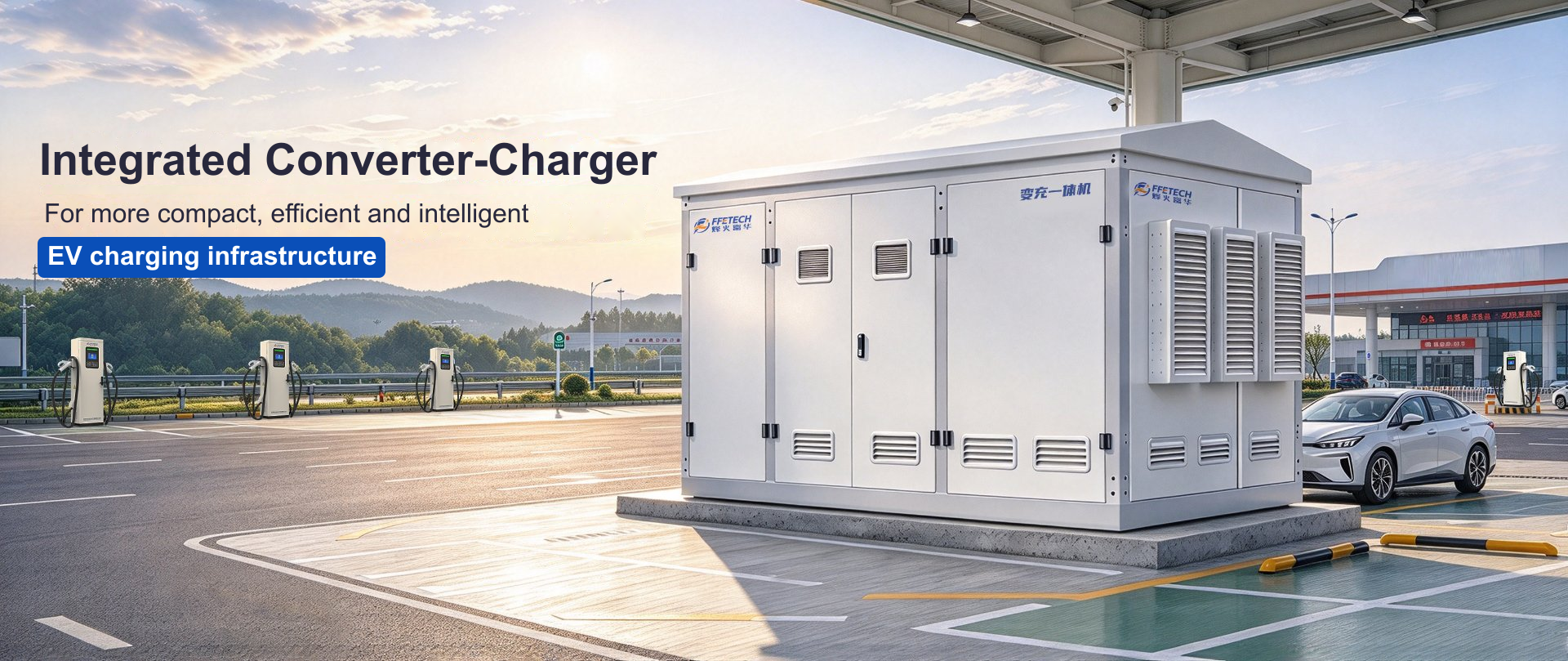
As a national-level "Little Giant" enterprise specializing in specialized, refined, distinctive and innovative technologies, Wuhan FiberHome Fuhua Electric Co., Ltd. (FFTECH) draws on years of expertise in smart power distribution and high-power charging equipment. To address these industry pain points, FFTECH has launched an integrated converter-charger solution that deeply combines the substation's transformation section with the charging rectification system — integrating transformation, voltage conversion, rectification, power conversion and intelligent power distribution into a single unit. The result is an integrated "energy heart" for the station: a new, highly integrated charging infrastructure that solves the many challenges of building high-power charging stations.
1. Why Did the Integrated Converter-Charger Emerge?
The growing fast-charging power of new energy vehicles is one of the key reasons behind the integrated converter-charger.
In the early days, a single charging gun might deliver only tens of kilowatts, and the total power of a charging station was relatively low. Under those conditions, using a conventional separate box-type substation and rectifier cabinet posed few obvious problems.
Today, however, high-power fast charging has become the trend. A public charging station may be built with hundreds of kilowatts, or even megawatt-level, charging capacity. A large station, for example, may be equipped with multiple charging terminals to serve several new energy vehicles charging at the same time.
As charging power continues to rise, the problems of the conventional split system become increasingly pronounced.
On the one hand, the number of pieces of equipment grows. In addition to the box-type substation, separate rectifier cabinets, terminal cabinets and the corresponding cable connections are required.
On the other hand, a large number of electrical connections between devices are needed. Power distribution is required on the AC side, while power aggregation and distribution take place on the DC side. Internal connection distances are long, which not only increases the use of copper cables and other materials, but also adds to the workload of design, installation and maintenance.
At the same time, conventional equipment is usually arranged in a decentralized layout, taking up more space. In land-scarce locations such as urban parking lots, commercial centers and older parking facilities, "where to put the equipment" can itself become a major obstacle to getting a project off the ground.
The industry therefore began to consider a very direct question:
Since power transformation and charging are two links in the same energy-conversion chain, can they be integrated?
The answer is the integrated converter-charger — also a next-generation charging infrastructure product direction that FFTECH is actively developing.
2. What Exactly Is an Integrated Converter-Charger?
From a technical standpoint, the integrated converter-charger can be understood as a highly integrated energy-conversion device following the sequence of "medium-voltage AC input — transformation — low-voltage AC distribution — rectification — DC output."
A typical energy flow can be expressed simply as:
Grid → Medium-voltage switchgear → Transformer → Charging rectifier module → DC bus → Charging terminal → New energy vehicle
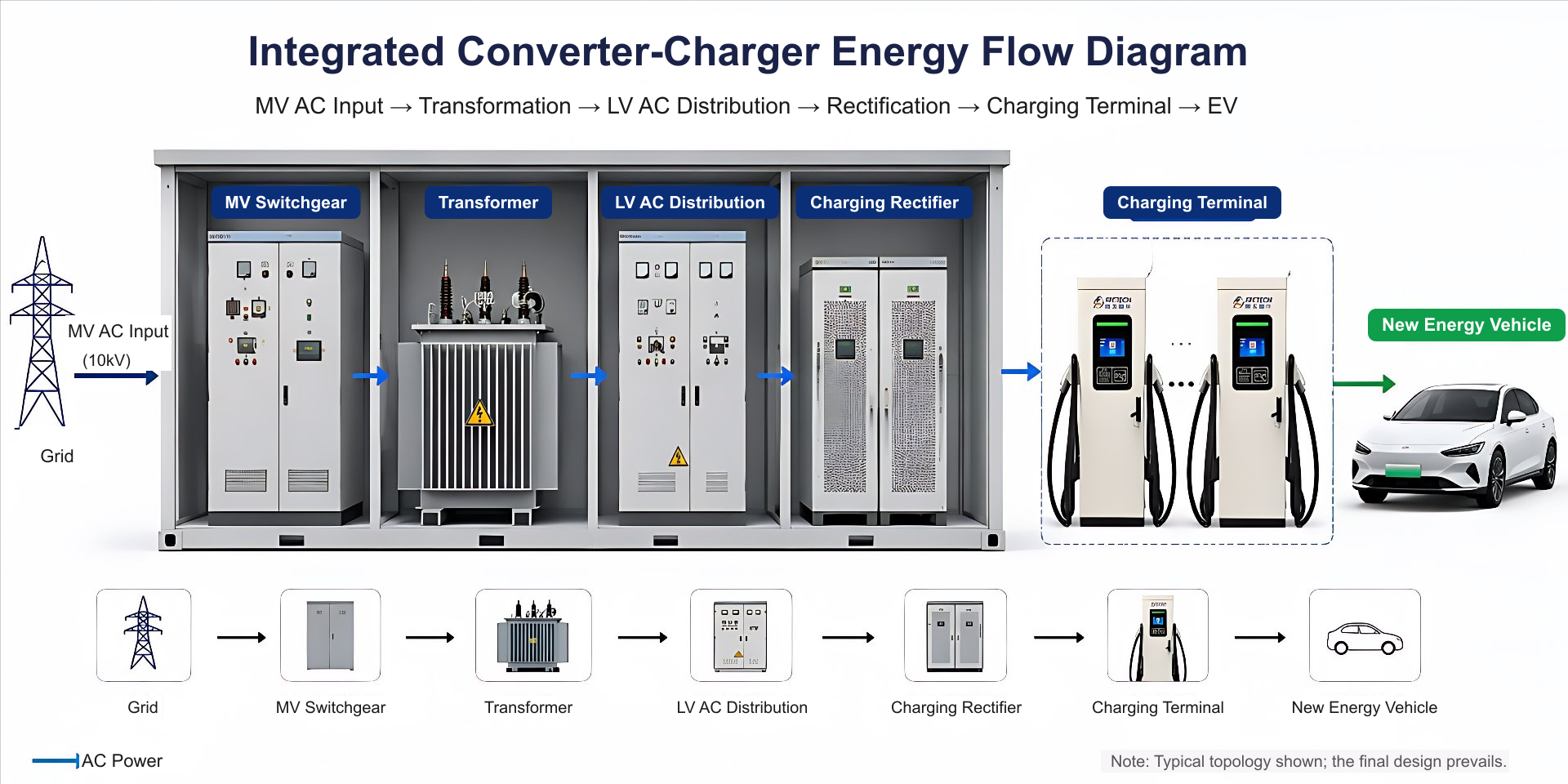
In conventional solutions, these functions are housed in separate, independent cabinets and equipment.
FFTECH's integrated converter-charger, by contrast, integrates these key links into a single equipment platform, bringing together the transformer, rectifier cabinet, power modules, power-distribution system and monitoring system.
From the user's point of view, it still performs the same functions as a conventional charging station:
Electrical energy is supplied from the grid;
The transformer steps the voltage up or down;
The charging modules perform AC/DC conversion;
The control system dynamically allocates charging power according to vehicle demand;
Finally, high-power DC fast charging is delivered to the new energy vehicle through the charging terminals.
Structurally, however, it has evolved from "a combination of several independent devices" into "a single integrated unit."
This is the defining characteristic of the integrated converter-charger.
3. Core Features of the Integrated Converter-Charger
Deep integration of power transformation and charging. A conventional charging station requires a box-type substation and a charging rectifier cabinet to be built separately. FFTECH's integrated converter-charger deeply merges the two, both structurally and electrically. This design gives the equipment clearer functional boundaries and reduces duplicated components between devices. For the station developer, the integrated converter-charger can be thought of as a complete "charging energy center."
More compact equipment and a smaller footprint. For urban charging stations, land and space are often at a premium. A conventional split layout requires separate installation space for the box-type substation, rectifier cabinet and power-distribution equipment, as well as reserved maintenance aisles between them. Through structural optimization and equipment integration, the integrated converter-charger significantly reduces the space redundantly occupied between devices. This advantage is especially evident where space is limited — urban parking lots, shopping malls, industrial parks and bus depots. In other words, work that once required multiple "equipment units" can now be accomplished within a single "energy equipment unit."
Fewer intermediate electrical connections and higher system integration. In conventional systems, low-voltage distribution, busbars or cables typically connect the transformer to the rectifier cabinet. FFTECH's integrated converter-charger optimizes its internal busbars, low-voltage distribution and DC power system to make the energy-transmission path more compact. Shorter equipment distances help reduce cable usage and the number of connection points, thereby reducing potential failure points. For high-power systems, this structural optimization has significant engineering value.
Easier installation and shorter project timelines. Building a conventional charging station often requires the coordination of multiple specialized contractors, covering transformation equipment, low-voltage distribution, rectification equipment, charging equipment and communication control systems. FFTECH's integrated converter-charger completes more of the integration and testing at the factory. Once the equipment arrives on site, only the foundation work, grid connection, charging terminal connections and necessary commissioning are needed before it is ready for operation. This model of "factory pre-integration, fast on-site installation" effectively reduces on-site construction work — especially important for chain charging stations, logistics parks and large new-energy infrastructure projects that need to be replicated quickly.
4. Five Key Advantages of the Integrated Converter-Charger
First, lower overall construction costs. The integrated converter-charger is not simply two devices placed side by side; it reduces duplicate cabinets, redundant power distribution, and part of the cabling and connection facilities through system-level design. Its value therefore cannot be measured simply by "equipment purchase price," but should be viewed across the entire project lifecycle. Fewer devices, less floor space, less construction work, less cabling and less commissioning all translate into lower overall project costs.
Second, better space utilization. At urban charging stations where land is extremely valuable, the space saved is itself valuable. With a smaller equipment footprint, the same station area can accommodate more parking spaces and charging bays, improving the asset-utilization efficiency of the whole station. This value is even more pronounced in areas with high land costs.
Third, improved system reliability and maintainability. Once integrated, a unified control, monitoring and protection system enables centralized management of the transformer, rectifier modules, power-distribution system and charging power. FFTECH's integrated converter-charger is equipped with a proprietary monitoring and management platform for centralized control of the entire system. For example, when the system detects that a charging module is abnormal, it can automatically reduce that module's output power, or redistribute power to transfer part of the charging demand to other modules. The modular design also allows fast localization and maintenance when a localized fault occurs. This upgrades the charging system from traditional "equipment management" to "system management."
Fourth, greater flexibility in charging power configuration. Different new energy vehicle models have different charging power requirements. One vehicle may need only tens of kilowatts, while another may need hundreds. FFTECH's integrated converter-charger, through its power modules and charging terminal configuration and dynamic power distribution, delivers "power on demand." For example, when only a few vehicles are charging, some power modules can be kept at low load or in standby; when several vehicles charge at once, more power modules are automatically brought online. This improves equipment load rates and operating efficiency, and helps reduce unnecessary standby losses.
Fifth, a foundation for future smart charging. The core competitiveness of future charging stations will lie not only in charging "fast," but in charging "smart." As energy storage, photovoltaics, V2G, demand response and virtual power plants continue to develop, charging stations will no longer be mere electricity-consuming equipment, but promising flexible energy nodes within the grid. FFTECH's integrated converter-charger has strong inherent capabilities in power conversion and control, and can be further combined with photovoltaics, energy storage and energy management systems. The result can be an integrated energy system of grid + integrated converter-charger + energy storage + photovoltaics + charging terminals + EMS. This will transform charging stations from pure "electrical loads" into "smart energy nodes" capable of optimized energy management.
5. Which Applications Suit the Integrated Converter-Charger?
The integrated converter-charger is not limited to one type of charging station; it is especially suited to scenarios that demand high power, high integration and fast construction.
Urban public fast-charging stations. Urban parking lots have scarce land resources, so the smaller the equipment footprint, the greater the advantage. The integrated converter-charger reduces the space taken by conventional equipment, creating room for more charging bays.
Highway service areas. Service areas must handle concentrated charging demand during holidays and other peak periods, while also facing site and construction-cycle constraints. The integrated converter-charger enables rapid deployment of transformation and charging systems, making it well suited to high-power fast-charging stations.
Logistics parks and heavy-truck charging stations. As new-energy heavy trucks develop rapidly, their charging power is significantly higher than that of ordinary passenger vehicles; in the future, heavy-truck stations may see megawatt-level or higher charging demand. In such scenarios, system integration, power density and reliability are especially critical — areas where the integrated converter-charger has strong application potential.
Bus depots. Buses follow fixed routes and schedules and charge in a concentrated manner, placing high demands on charging power and system stability. By deploying integrated converter-chargers centrally, multiple charging terminals can be supplied and managed uniformly.
Industrial parks and smart parks. Parks typically combine offices, production, parking, photovoltaics and energy storage. The integrated converter-charger can serve as a key power-conversion device for new energy vehicle charging in the park, and integrate further with the park's microgrid and energy management system.
6. From "Charging Equipment" to "Energy Infrastructure"
If a conventional charging pile is the "fuel nozzle" of a new energy vehicle, then the integrated converter-charger is closer to the "energy heart" of the entire charging station.
Its role is not merely to "deliver power to the vehicle," but to carry out the key work across the entire energy-conversion chain from the grid to the new energy vehicle.
Looking ahead, as new energy vehicles continue to grow in number, charging stations grow in scale and charging power rises, the traditional model of "assembling several independent devices" will gradually give way to one that is "modular, integrated and intelligent."
The integrated converter-charger is a new type of power equipment born of this trend.
Its significance goes well beyond "a few fewer cabinets." More importantly, through system-level redesign, it achieves higher integration, a smaller footprint, fewer connections, faster construction, more flexible charging and smarter energy management.
7. Where Is the Integrated Converter-Charger Headed?
The integrated converter-charger of the future will continue to evolve toward higher power density, modularity, intelligence and multi-energy integration.
On one hand, as fast-charging technology for new energy vehicles advances, charging power will keep rising, requiring the integrated converter-charger to deliver stronger power-conversion capability and higher power density.
On the other hand, advances in liquid-cooled charging modules, intelligent power distribution, high-efficiency transformers and new power electronic devices will drive further miniaturization and efficiency.
At the same time, the integrated converter-charger can be deeply combined with energy storage systems.
For example, at sites with limited grid capacity, an "integrated converter-charger + energy storage" configuration can raise charging power without significantly increasing grid-connection capacity, enabling peak shaving and valley filling and flexible capacity expansion.
Combined further with photovoltaics, it can form an integrated "PV + storage + conversion + charging" energy system.
In the future, as V2G technology matures, new energy vehicles may even shift from "electrical loads" to "mobile energy storage units," enabling two-way interaction between vehicles and the grid.
By then, the integrated converter-charger will be far more than a piece of charging equipment; it may become a vital energy interface connecting the grid, photovoltaics, energy storage and new energy vehicles.
Conclusion: The Integrated Converter-Charger Ushers Charging Infrastructure into the Era of "System Integration"
The growth of new energy vehicles is driving profound change in charging infrastructure.
From single-pile charging in the early days to high-power fast charging; from standalone charging equipment to charging-station energy systems; from simply "being able to charge" to "charging fast, economically and intelligently" — charging infrastructure is continuously evolving.
The integrated converter-charger is an important product form within this evolution.
By deeply integrating the box-type substation with the split-type charging rectifier cabinet, the integrated converter-charger performs the core functions of transformation, rectification and charging energy management within a single system. It offers clear advantages in saving space, simplifying systems, lowering construction costs, shortening construction cycles and raising intelligence levels.
For equipment manufacturers, the integrated converter-charger represents not only a new product, but a shift from "manufacturing individual devices" to "manufacturing system-level energy equipment."
For charging operators, it means more compact, efficient and flexible charging infrastructure.
For the new energy vehicle industry, it will further lower the barrier to building high-power charging stations and accelerate the rollout of fast-charging networks — a direction in which FFTECH continues to invest deeply.
And for the future energy system, it is poised to become a key node connecting the grid, new energy sources, energy storage and new energy vehicles.
It is foreseeable that, as new energy vehicles achieve large-scale adoption and new power systems continue to be built, the integrated converter-charger will find ever broader applications, driving new energy vehicle charging infrastructure from traditional "charging equipment" toward a new generation of more efficient, intelligent and integrated power and energy equipment.