
While we indulge in streaming videos, playing games online, or video-calling family and friends, the communication towers standing tall across city streets and alleys, on rooftops and hilltops, are silently transmitting signals for us.
As the neural endings of the modern information society, these mobile communication base stations consume electricity continuously to guarantee uninterrupted 24/7 signal coverage. You may not know it, but these seemingly unremarkable towers are, in fact, out-and-out power tigers.
With the advancement of new-energy technologies, FFTECH’s golden combo of photovoltaics + energy storage + hybrid inverter—designed for the base-station scenario—is quietly making its way into tower base stations. Today, let us take a closer look at how tower base stations achieve a stunning transformation through adding energy storage: slashing electricity bills while also helping China Tower shoulder its burdens.
01
The “Electricity Consumption Portrait” of Tower Base Stations: Stable yet Substantial Overhead
To solve the energy consumption problem of base stations, we must first understand their electricity usage characteristics.
Unlike the fluctuating load in our homes, the electricity consumption of tower mobile communication base stations can be summed up in one word: stable.
• Daily electricity consumption is fixed: a standard base station consumes about 100 kWh per day, with very little fluctuation due to weather or user traffic.
• Annual electricity consumption is considerable: day after day, one base station uses as much as 35,000 kWh per year.
One hundred kWh per day may not sound like much, but multiplied by the millions of base stations operated by China Tower, it becomes an astronomical figure. Under the traditional power-supply model, base stations rely entirely on dedicated grid power lines, and electricity bills are a huge, rigid operating cost. How can this bill be reduced while ensuring communication security? The answer is—a distributed solar-plus-storage system.
02
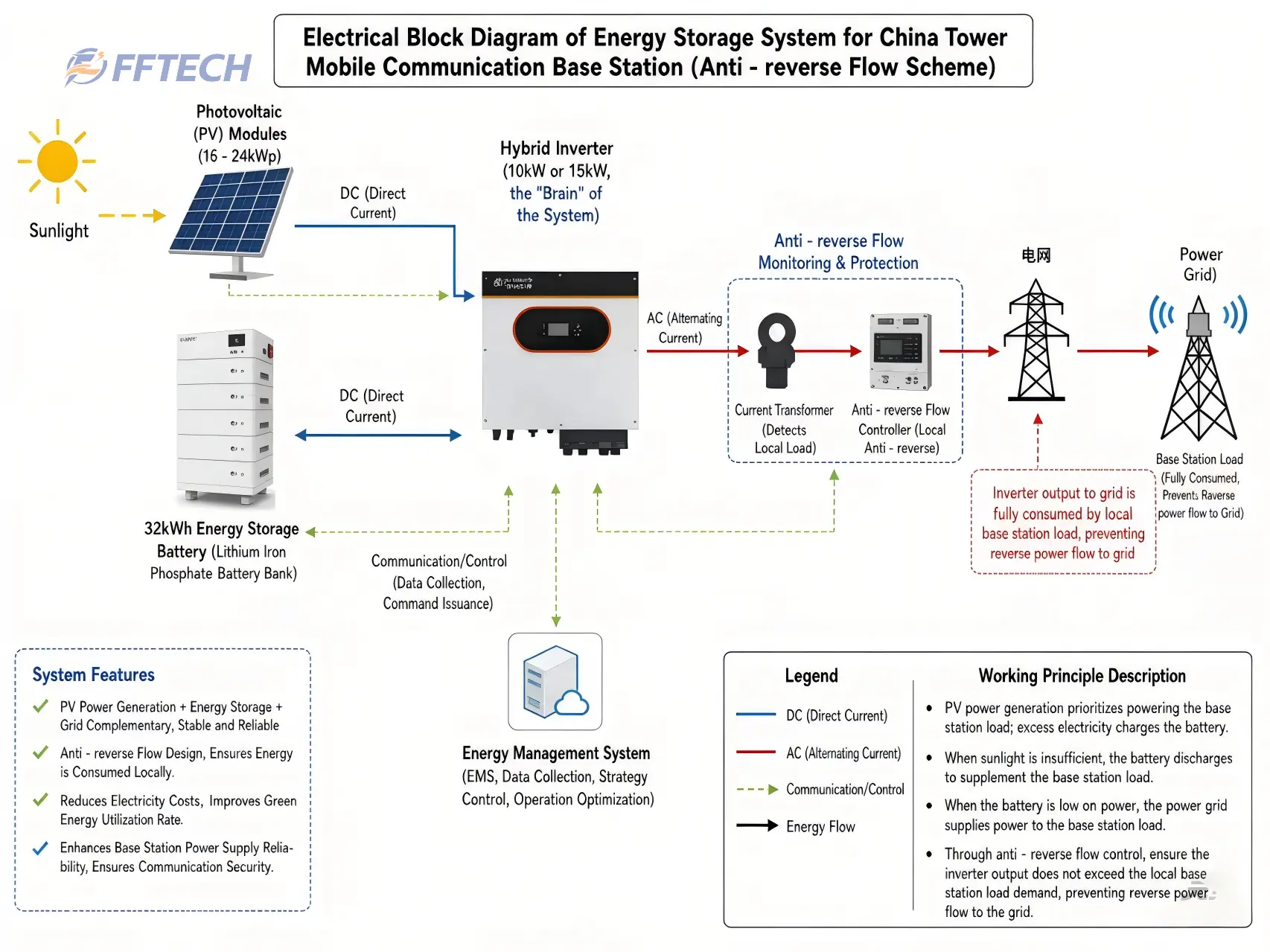
The Golden Combo: 10 kW/15 kW Hybrid Inverter + 32 kWh Storage Battery + PV
To meet the rigid demand of a daily 100 kWh load, FFTECH has developed a highly cost-effective green standard solution:
.webp)
Core Configuration List
Why is this configuration the Golden Ratio?
Let us do a quick calculation. A base station consumes 100 kWh per day, meaning its average operating power is about 100 kWh ÷ 24 h = 4.17 kW.
1. The inverter is just right: a 10 kW or 15 kW hybrid inverter easily meets the base station’s ~4.17 kW daily operation, while leaving ample power headroom to simultaneously drive the base station and charge the battery at maximum efficiency when sunlight is abundant during the day.
2. The battery capacity is just right: the 32 kWh storage battery can cover nearly one-third of the base station’s daily total electricity consumption. This capacity is neither so large that the investment sits idle, nor so small that it fails to provide emergency backup and cost savings—it is arguably the sweet spot for the highest return on investment (ROI).
03
Dual Benefits: How the Storage System Helps the Tower Make Money
Once this system is installed, the base station is transformed from a pure consumption terminal into a micro smart grid. Its benefits come mainly from two dimensions:
1. Green Self-Consumption: Getting Free Electricity from the Sun
On a sunny day, the PV panels get to work with gusto.
• Priority self-consumption: the PV-generated electricity is supplied directly to the base-station equipment—every kWh generated means one less kWh purchased from the grid.
• Charging with surplus: if midday PV output exceeds base-station consumption (e.g., reaching 8 kW), the surplus is not wasted; the inverter directs it into the 32 kWh battery.
• Evening release: at night or on cloudy and rainy days, the green electricity stored in the battery is discharged to power the base station. In and out, the base station’s reliance on expensive utility power is greatly reduced.
2. Peak-Valley Electricity Price Arbitrage: Making Sense of Time-of-Use Pricing
In many Chinese provinces that implement time-of-use (peak-valley) pricing—such as Zhejiang, Guangdong, and Jiangsu—electricity prices differ drastically by time period. Peak rates can be as high as ¥1.2/kWh, while valley rates (usually late at night) may be only about ¥0.3/kWh.
With this system, the base station learns the survival wisdom of buy low, sell high:
• Fully charged at midnight: during the late-night valley period, the system controls the inverter to draw cheap power from the grid and fully charge the 32 kWh battery (costing only about ¥10).
• Off-grid at peak: during the daytime peak-price period, the system actively reduces or stops buying power from the grid, letting the battery discharge to supply the base station—perfectly avoiding the steep peak electricity fees.
With the dual boost of PV self-consumption and peak-valley arbitrage, the ROI of this scenario is impressive. In provinces with large price spreads, the entire system’s investment is typically recouped in 3 to 5 years, while the designed service life of the system is generally 10 years or more—meaning every subsequent year is pure profit.
04
More Than Saving Money: A Stabilizing Anchor Guarding Communication Security
Beyond the eye-catching economic returns, tower base-station energy storage also plays a crucial social role—as an emergency backup power source.
In the past, if the grid failed due to a typhoon, heavy rain, or earthquake, base stations could only rely on traditional lead-acid batteries to keep running for a short time. Once the lead-acid batteries were exhausted, communication would be cut off. To restore signal, maintenance crews even had to haul heavy diesel generators into disaster areas against the flow of traffic—inefficient and posing safety risks.
Nowadays, a 32 kWh lithium storage battery offers extremely high energy density and an ultra-long cycle life. When the grid suddenly loses power, the hybrid inverter can switch the system to off-grid power supply mode in an instant (microseconds). These 32 kWh of electricity can independently support the normal operation of the base station for 7–8 hours even without sunlight. On a sunny day, coupled with PV generation, it can even achieve unlimited endurance. In the event of a disaster, this green signal lifeline will remain online forever.
05
Looking Ahead: From Going It Alone to a Connected Web of Thousands of Grids
Today, tower base-station energy storage may only be saving electricity for itself; but looking ahead, these systems will converge into a force capable of changing the nation’s energy landscape.
√ Virtual Power Plant (VPP) Cell Units
In the future, tens of thousands of tower base stations equipped with energy storage systems can be connected via a cloud platform and placed under the unified dispatch of the grid. When the national grid load is too high, these base stations can collectively go off-grid and discharge, helping the grid shave peaks; when grid power is in surplus, they can collectively charge to absorb the excess electricity. This is the concept of the virtual power plant. By then, China Tower will no longer be just a communications service provider, but a distributed super virtual power plant.
√ A Second Spring for Retired Power Batteries
With the explosive growth of new-energy vehicles, vast numbers of power batteries will be retired in the future. Although these batteries can no longer take a car very far, their State of Health (SOH) is often still around 70%–80%, making them well suited for downgraded use in base-station storage, where space constraints are less critical. This cascaded utilization will not only significantly reduce the upfront investment cost of base-station storage, but also realize a green, full-life-cycle cycle for batteries.
√ An AI-Driven Smart Brain
Future hybrid inverters will be even smarter. Combined with AI algorithms and weather forecasts, the system can predict tomorrow’s solar power generation in advance; coupled with the dynamically adjusted time-of-use price rules of each province, AI can automatically calculate the optimal charge-discharge curve, squeezing the value out of every single kWh of electricity.
06
Conclusion
The towering masts not only bring people closer to one another, but are also quietly changing the relationship between us and energy.
Through the small change of 10 kW/15 kW hybrid inverter + 32 kWh storage battery + PV, FFTECH turns every tower base station into a green, intelligent, low-carbon energy cell. This is not only progress in information and communication technology, but also a vivid practice—full of wisdom and cost-effectiveness—in China’s march toward its dual carbon goals. In the future, the next time you see a communication tower by the roadside, you might just salute it: it is not only transmitting your 5G signal, but also quietly guarding our green mountains and clear waters.